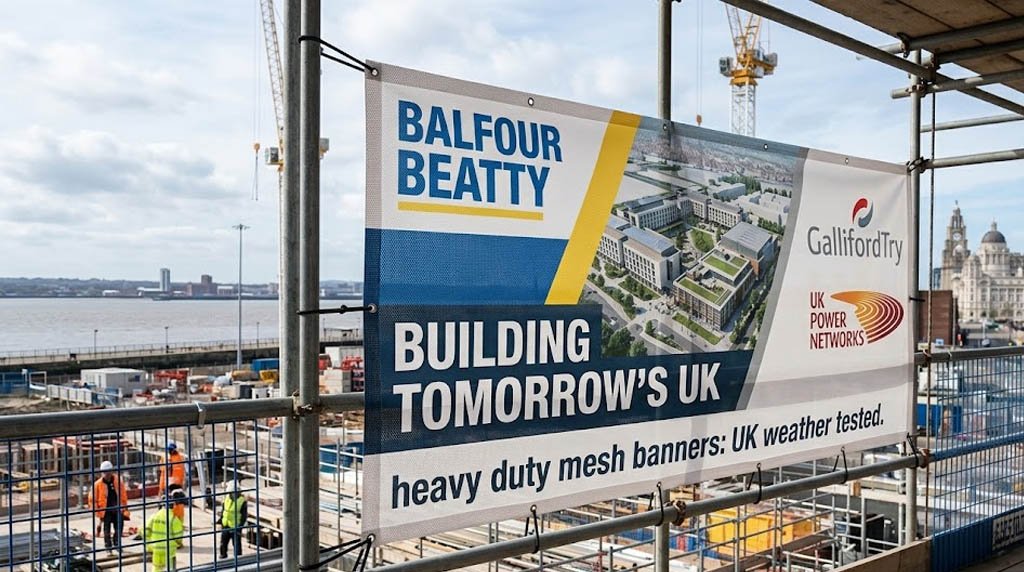
If you’ve ever installed a large outdoor banner in the UK, you’ve seen the real problem: wind load. A solid PVC banner can act like a sail—flapping, pulling at fixings, and sometimes tearing long before the campaign is over.
Mesh fabric banners solve this in a simple, engineered way: they let air pass through. The result is a display that stays tighter, looks more professional, and puts less stress on your fence, scaffold, or frame.
Key Takeaway: In exposed UK locations, mesh isn’t a “premium upgrade”—it’s often the correct material choice because airflow reduces wind load and the edge/eyelet zone fails less often.
The science behind wind permeability and banner longevity
Wind damage usually isn’t about ink. It’s about force.
When wind hits a solid surface, pressure builds and the banner bows outward. That repeated billowing (plus sharp gusts) concentrates stress along the perimeter—especially at the corners, hems, and eyelets.
Mesh banners reduce the “sail effect” because the structure is perforated/open-weave. According to Bannerbuzz UK’s explainer on how mesh reduces wind loading compared to solid vinyl, letting wind pass through materially reduces the pulling force on fixings.
How much airflow is “normal” for mesh?
Airflow varies by product. There isn’t a single universal spec—but you can ground your decision in a realistic range:
Endutex UK notes that typical mesh airflow rates are about 25%–65% depending on the mesh structure.
SignCenter adds that ~30% airflow is common for mesh banners, with some products offering higher airflow.
In practical buying terms, the key is this: more airflow generally means less wind load (and less flapping), but it can slightly reduce colour saturation versus a fully solid face.
Pro Tip: Don’t treat “airflow %” as marketing fluff. Ask for it when the installation is exposed—coastal venues, open fencing, sports grounds, or high scaffolding.
Outdoor mesh banner printing UK: the spec checklist that prevents wind failures
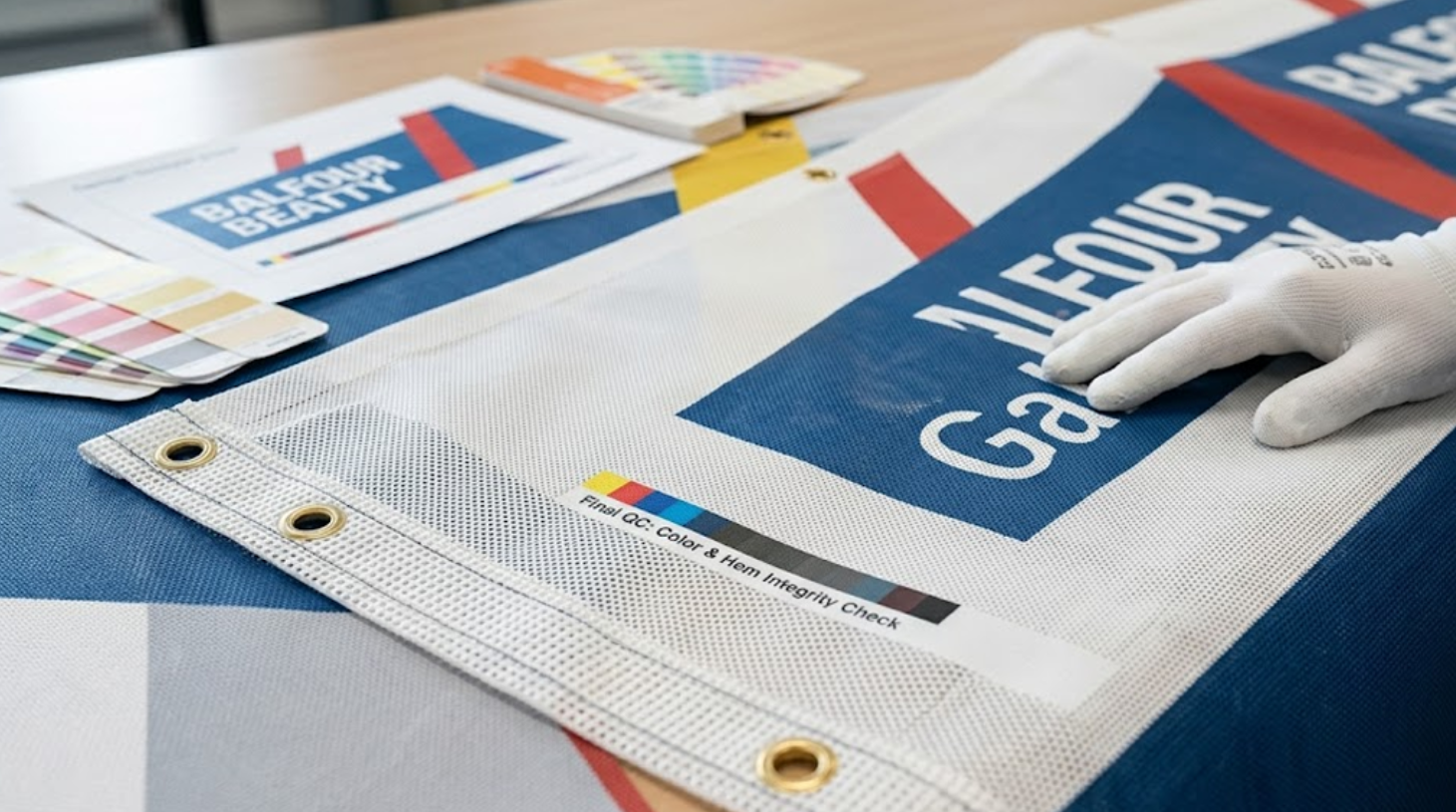
If you’re buying outdoor mesh banner printing UK suppliers will all sound similar. The difference is whether the spec is written to survive gusts.
Use this quick checklist before you approve artwork or sign off on a PO:
Confirm airflow/open area (ask for the product’s stated wind pass-through)
Specify reinforced hems (not just “hemmed”)
Specify rust-resistant eyelets/grommets
Confirm eyelet spacing is appropriate for the size and exposure
Confirm fixing method (bungees/cords/fasteners with a little give, not a drum-tight pull)
This is also where heavy duty mesh banners earn their name: finishing, reinforcement, and hardware—not a vague label.
Comparison: mesh fabric vs. solid PVC banners
For UK buyers, the decision is usually straightforward:
Choose mesh when the banner is exposed to frequent gusts and you need stability.
Choose solid PVC when wind exposure is low and maximum colour punch is the priority.
Here’s a quick comparison you can use in a spec sheet or procurement brief.
Criteria | Mesh fabric banner | Solid PVC banner |
|---|---|---|
Airflow / wind load | Air passes through the structure, reducing the “sail effect” and stress on fixings | Minimal airflow; higher wind load, more flapping and pull |
Durability outdoors | Typically better in exposed/windy installs because load is reduced at edges/eyelets | Can be durable, but more likely to fail early in windy, open installs |
Print quality | High-resolution is achievable, but ultra-saturated blocks may appear slightly less dense because of perforation | Very strong colour density and solid fills |
Best use case | Construction fencing, scaffold wraps, festivals, sports events, coastal or open areas | Sheltered storefronts, indoor signage, low-wind outdoor placements |
Risk profile | Lower structural stress; fewer “banner becomes a sail” incidents | Higher structural stress; needs more conservative sizing + robust fixings |
Heavy duty mesh banners: what “heavy duty” should actually mean
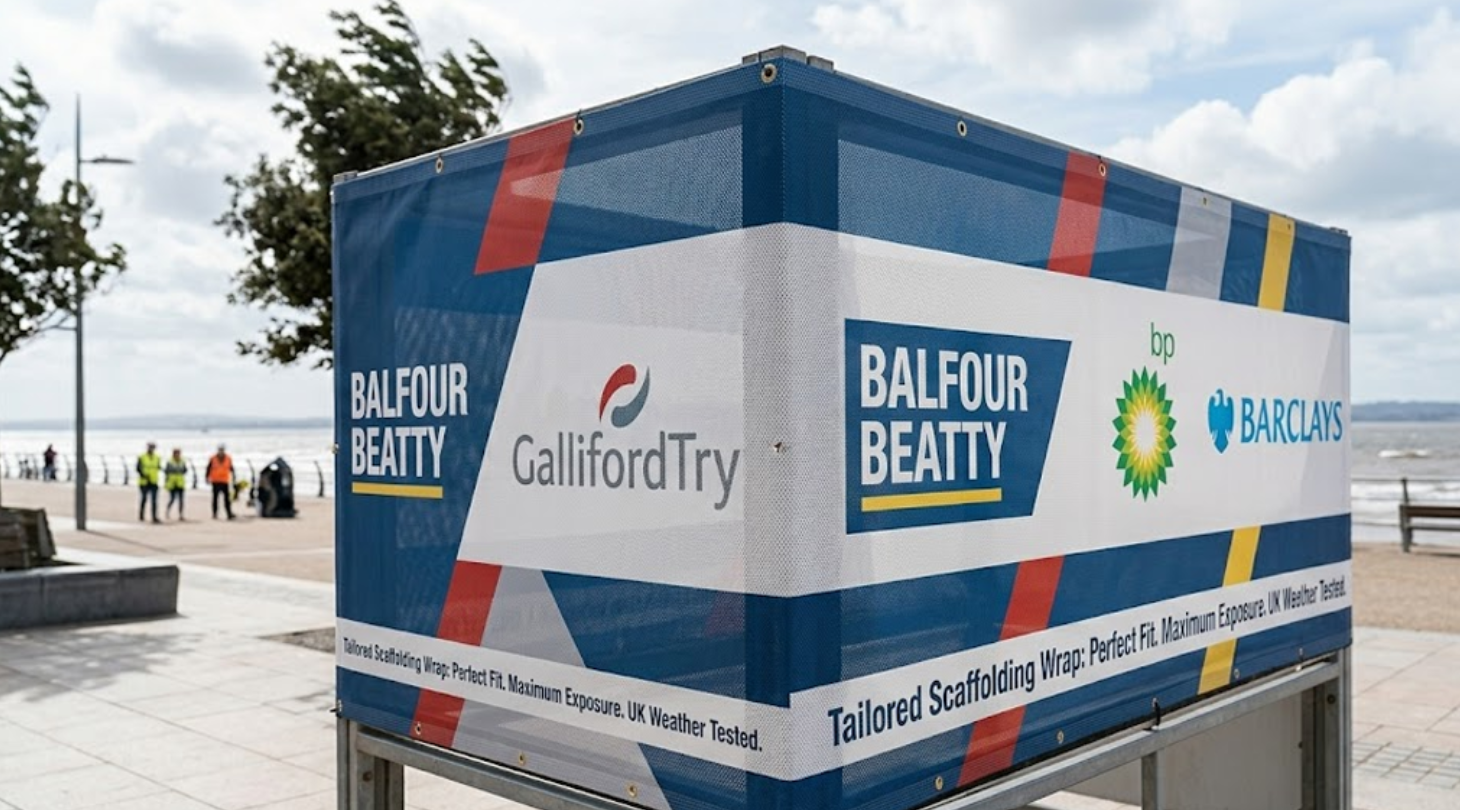
“Heavy duty” is often used loosely. For wind-exposed installs, it should translate into finishing and hardware choices—not just a tougher-sounding label.
If you’re specifying heavy duty mesh banners, look for:
Reinforced hems (not just a light fold)
Rust-resistant eyelets/grommets suitable for rain and coastal air
Even eyelet spacing, with extra attention at corners and long runs
A fixing method with some give (so gusts don’t concentrate force at a single point)
On iPopupBanner’s mesh fence banner page, they describe a setup with 35% wind pass-through plus reinforced edges and rust-proof brass grommets—the combination that matters in real wind.
Critical features for UK weather: reinforced hems and rust-free eyelets
If a banner fails, it usually fails at the perimeter.
1) Reinforced hems (the first line of defence)
A hem distributes load along the edge instead of letting it rip from a single hole. In windy UK installs, a reinforced hem helps in two ways:
Reduces tear initiation at the edge
Spreads tension so the banner doesn’t “drum” and fatigue the material
When you review a quote, look for explicit finishing language (for example: reinforced hem, sewn hem, welded edge, or webbing reinforcement). If the finishing is vague, your durability is guesswork.
2) Rust-free eyelets/grommets (so the fixing points stay strong)
Eyelets are where the banner meets the real world. In wet weather, poor hardware can corrode, deform, or cut into the material.
What to specify:
Rust-resistant eyelets/grommets for long outdoor runs
Spacing that matches exposure: closer spacing for long spans and windy sites
Corner reinforcement (because corners see peak load)
⚠️ Warning: Over-tightening is a common failure mode. If the banner is drum-tight, gusts don’t dissipate—they spike at the fixings.
Why our manufacturing process guarantees a premium finish
In the consideration stage, buyers aren’t just choosing a material—they’re choosing a risk profile.
At Vancke, the goal is simple: make outdoor banners predictable. That means controlling the steps that typically cause reprints and site issues:
Free design + proof approval: you see the layout, sizing, and safe margins before production.
Manufacturing consistency: repeatable colour and finishing standards matter when you’re deploying multiple banners across locations.
QC mindset: edges, eyelets, and final trim are where failures start—so they can’t be an afterthought.
Logistics transparency: reliable timelines reduce the “arrived late / installed rushed” scenarios that lead to bad installs and early damage.
If you’re sourcing for a construction perimeter, sports event, or festival run, that process discipline is what keeps the branding looking sharp on day 1—and still presentable after weeks of wind and rain.
FAQ: outdoor mesh banners in windy UK locations
Do mesh banners work in rain?
Yes—mesh is primarily about wind relief. Rain exposure is handled through material choice and ink/print method. The key is specifying outdoor-ready materials and finishing.
Will mesh reduce print clarity?
Most designs still print sharply. The trade-off is usually in solid colour density (large blocks may appear slightly less “filled” because of the perforation). For logos, text, and bold graphics, mesh typically performs well.
Is mesh always better than PVC?
No. If the placement is sheltered and your priority is maximum colour punch, solid PVC can be the better choice. Mesh is the better choice when wind exposure is the deciding factor.
Next steps: get the spec right before you print
If you want a quick sanity check before you place a large outdoor order, we can help you translate your install into the right spec (material + finishing + fixing approach).
Start with our free design services to share your size, placement, and artwork.