If you are ordering outdoor wayfinding for a trade show aisle, farmers market lane, or storefront curb, feather flag sizes decide whether buyers can read your mark from across the lot—or whether the pole clips a low hall ceiling. This guide locks the decision to live product heights on iPopupbanner’s custom feather flag page: S 8.5 ft (260 cm), M 10 ft (310 cm), L 13.5 ft (410 cm), and XL 16.5 ft (500 cm). Then you pick base hardware and single- vs double-sided print so the kit that ships matches the surface and traffic you actually have.
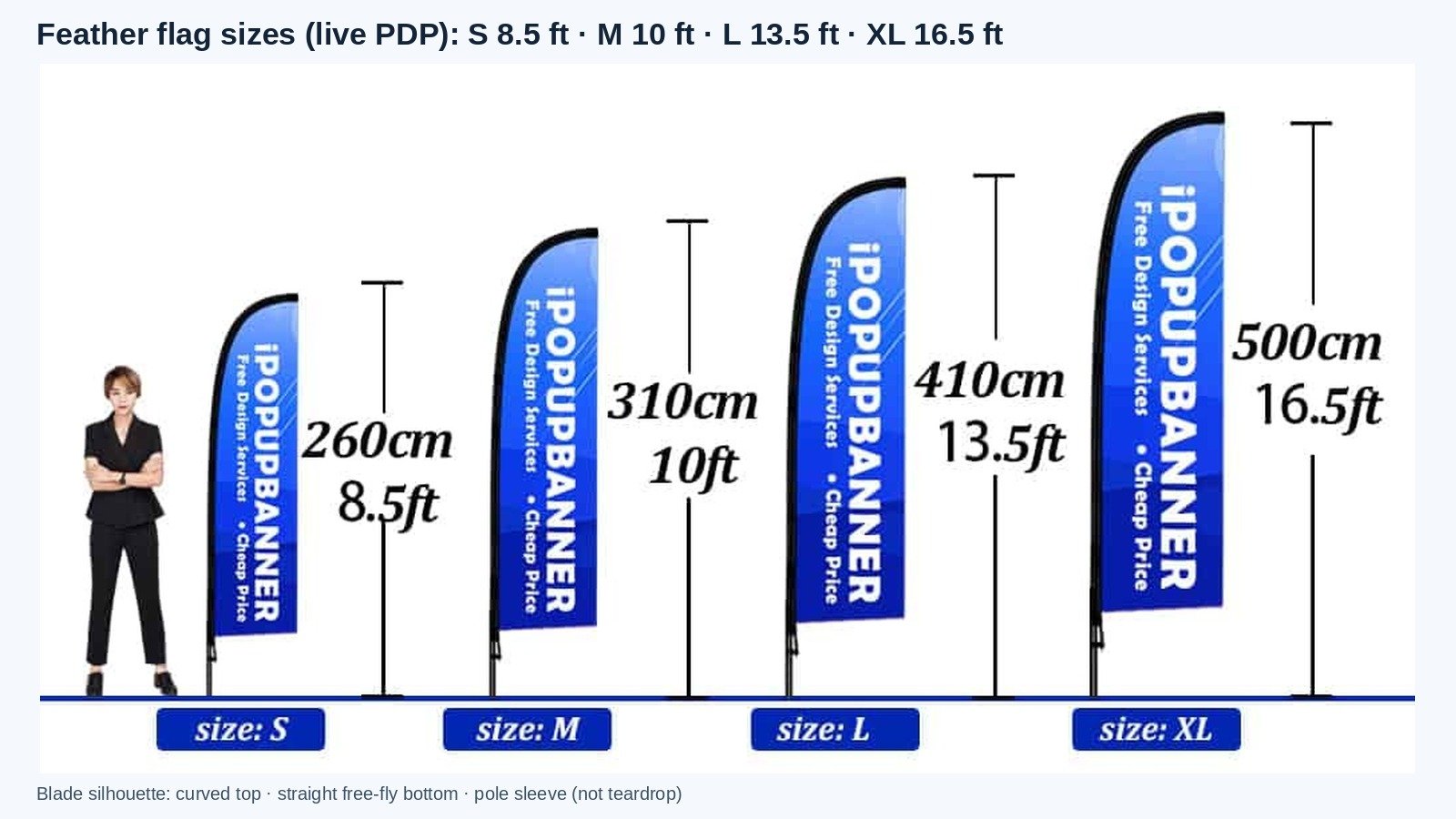
Feather flag sizes on the live PDP (S–XL)
Suppliers label “small / medium / large” differently. For RFQs on custom feather flags with pole and base, use these assembled heights only:
- S — 8.5 ft / 260 cm
- M — 10 ft / 310 cm
- L — 13.5 ft / 410 cm
- XL — 16.5 ft / 500 cm
The graphic is a blade/feather: pole sleeve on one edge, curved/rounded top, and a straight free-fly bottom. That is not a teardrop (which closes back to the pole). Poles are aluminum and fiberglass; pole kits are not interchangeable across heights, so size the kit once—do not plan to reuse an S pole on an L flag.
Match height to viewing distance and venue clearance
Think in three buyer jobs, not fashion:
- Indoor booth / low clearance (often S or M). Many halls restrict total height near 8–10 ft under lights and banners. S (8.5 ft) stays readable at aisle distance without dominating a 10×10. M (10 ft) works when the venue allows a bit more air and you need stronger pull from the next aisle over.
- Outdoor curb, market lane, or dealership lawn (often M or L). Pedestrians and slow traffic need height above parked cars and tents. M is the default sidewalk kit; L (13.5 ft) reads farther across a parking row when wind and clearance allow.
- Arterial road or large open venue edge (L or XL). XL (16.5 ft) is for long sightlines—stadium approaches, festival perimeter, big-lot frontage—not for a cramped indoor booth.
If your program spans indoor expos one week and outdoor weekends the next, order two height kits rather than forcing one pole into both jobs. That is usually cheaper than a damaged sleeve or a rejected venue inspect.
Cross base vs ground spike: pick the surface first
Hardware is part of the size decision because a tall flag on the wrong base tips or walks.
- Cross base with water bag — for hard surfaces (concrete, footpaths) and many grass setups when you cannot drive a stake. Live page notes the cross base at about 3.8 kg, with water-bag support when you need more mass. Filled bag weights on the page include a 24 lb water bag note and a broader 26–102 lb range for water or sand bags—confirm which bag you need on the RFQ.
- Inground spike — for soil, turf, and sports fields. The spike is a solid metal piece about 20 inches long (~1 kg) with a swivel so the flag can turn with the wind. Hammer only the spike section—not the swivel barrel—to avoid bearing damage.
For mixed tours (convention center carpet Monday, grass lot Saturday), many buyers keep one cross-base kit and one spike kit and swap the same height class of flag/pole. Remember: poles still match height; only the base swaps.
Single-sided reverse vs double-sided 3-layer
Print option changes readability and how the flag flies—especially at L and XL:
- Single-sided reverse — one printed layer with about 70–95% bleed to the reverse. Lighter; page guidance cites about 30 mph wind tolerance. Best when traffic is mostly one direction (roadside, train stop approach).
- Double-sided 3-layer — two prints sewn with a 100% blackout middle so both faces read correctly. Heavier and “don’t fly” as lively; page guidance cites about 17 mph. Prefer for sidewalks and markets where people walk both ways and need crisp logos on each face.
Polyester dye-sublimation is the fabric print method called out on the product page. Graphics outdoors in prolonged direct sun are described as typically showing noticeable fade in about 3 to 6 months of hard exposure; with proper storage and less continuous sun, flags are described as lasting 2+ years. Bring flags in during severe weather.
What ships in a complete feather flag kit
Unless you order flag-only or hardware-only, the complete set is: 1 custom flag + 1 pole set + 1 base + 1 carry bag (Oxford carry bag on the live page). Free design proof and free shipping windows are stated on the product page (shipping commonly summarized as within 5 to 12 days; one process block also says 7 to 10 days after payment—use the RFQ reply as the binding schedule). No MOQ: one flag or a wholesale run is welcome. Do not rely on blog dollar prices—ask for a current quote.
Need a closed-loop silhouette instead? Compare the sister SKU custom teardrop flags (fabric returns to the pole). For ground-level spring frames on turf sidelines, see pop-up A-frame banners.
Buyer checklist before you inquire
- Venue max height and indoor vs outdoor.
- Primary viewing distance (aisle / curb / arterial).
- Surface → cross base + bag vs spike.
- Traffic direction → single reverse vs double 3-layer.
- Artwork: send logos for free design, or use the site’s Photoshop/Illustrator templates without resizing the die line.
Next step: send size, print option, base style, and quantity on the feather flags banner product page—free design proof before payment.
FAQ: feather flag sizes and kits
What feather flag sizes does iPopupbanner list?
Four heights on the live quote form: S 8.5 ft (260 cm), M 10 ft (310 cm), L 13.5 ft (410 cm), and XL 16.5 ft (500 cm).
Are feather flag poles interchangeable between sizes?
No. Each height uses its own pole kit; the product FAQ states poles are not interchangeable across sizes.
Which base should I use on grass vs concrete?
Grass or soil: prefer the 20-inch inground spike (hammer the spike, not the swivel). Hard surfaces: cross base, usually with a water or sand bag for stability.
Single-sided or double-sided for a busy sidewalk?
If people approach from both directions and need a correct-reading logo on each face, choose double-sided 3-layer. For mostly one-way traffic, single-sided reverse is lighter and flies more readily.
For a neutral overview of outdoor advertising formats (context only—not a product claim), see Wikipedia’s page on out-of-home advertising.